
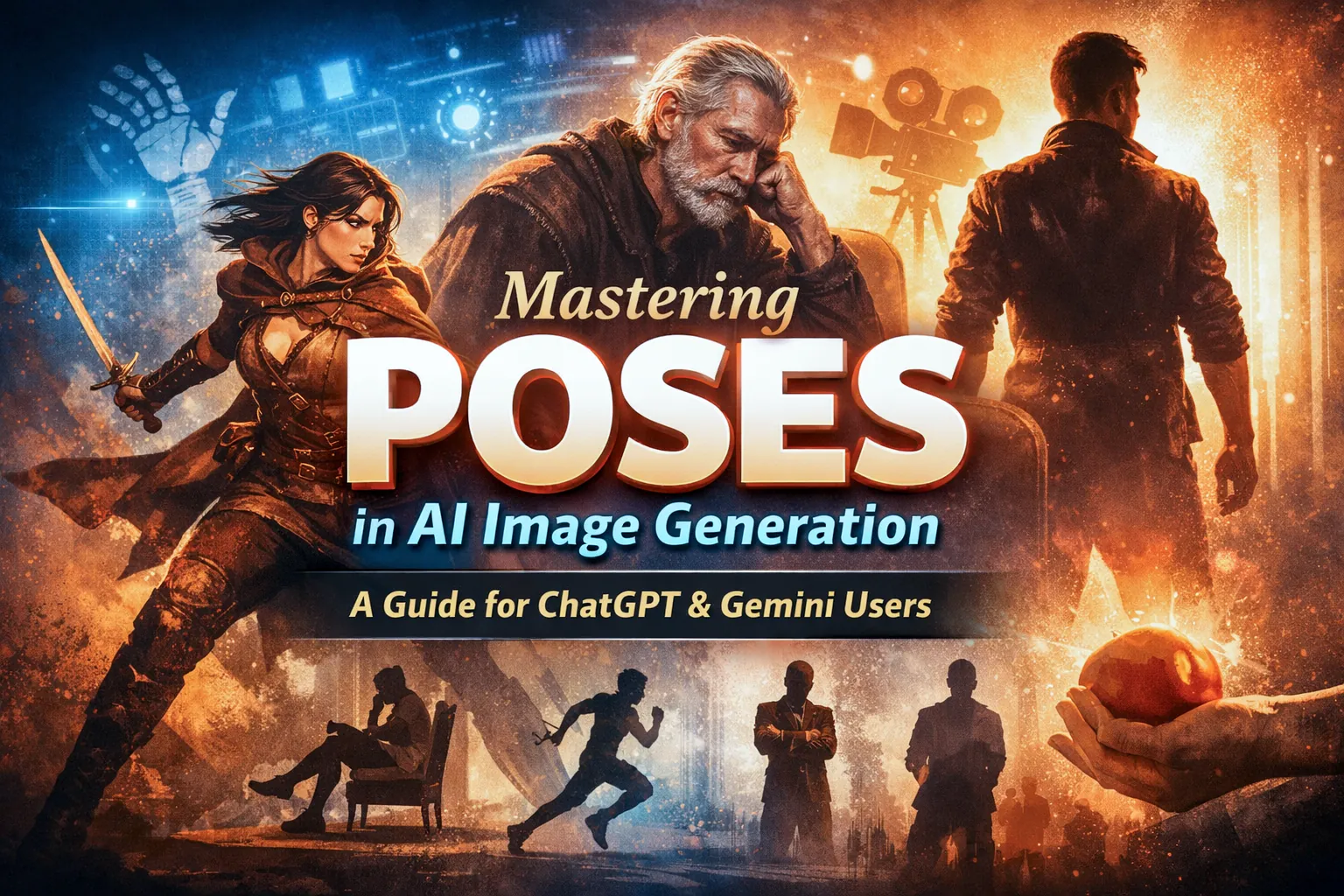
Poses in AI image generation are one of the biggest reasons images feel stiff, generic, or emotionally flat.
You ask ChatGPT to generate an image of a heroic adventurer.
It produces a high-quality image. The lighting is fine, details are sharp, but the character is standing stiffly in the center of the frame, doing nothing.
You ask Gemini for a sad scene.
The face shows a frown, but the body language feels neutral and the emotion does not land.
Why does this happen?
Conversational AI image tools are extremely good at understanding language. Because of that, they often try to interpret your request instead of following it literally. When you describe a character’s emotion but not their physical posture, the AI fills in the missing details using the safest possible option.
That safe option is almost always a neutral standing pose.
To get expressive, cinematic, or story-driven images from tools like ChatGPT (with DALL-E 3) and Gemini, you need to change how you prompt. You must stop describing feelings and start describing physics.
This guide shows you how to do exactly that using clear, natural language.
The “Conversational Trap”: Why Your Poses Feel Stiff
Unlike older tools like Midjourney or Stable Diffusion where you might use strings of keywords (e.g., full body, sitting, relaxed), conversational AI expects full sentences.
The mistake most users make is relying on abstract adjectives.
- Weak Prompt: “Generate an image of a tired, thoughtful wizard.”
- AI Interpretation: The AI knows what “wizard” looks like. It knows what a “tired face” looks like. It will likely generate a wizard standing up with baggy eyes. The body remains stiff.
- Strong Prompt: “Generate an image of a wizard sitting slumped in an armchair, leaning his head on one hand, staring at the floor.”
- AI Interpretation: The AI now has physical instructions. It doesn’t have to guess what “tired” looks like; it just has to render the physics of “slumped” and “leaning.” The result will look genuinely tired.
Poses are not decoration. They are the core of visual storytelling. This is why poses in AI image generation often look neutral even when the prompt sounds emotional.
Core Pose Categories in Natural Language
When using conversational AI, pose descriptions should feel like part of a sentence, not a list of keywords. The goal is to make the physical state of the body impossible to misinterpret. Understanding poses in AI image generation helps you control emotion, realism, and storytelling.
1. Neutral and Relaxed Poses
Use these for character portraits or fashion shots where the focus is on the subject’s features or clothing, not the action.
How to describe them conversationally:
- “…standing upright with a relaxed posture, arms resting naturally at their sides.”
- “…a casual seated pose on a bench, leaning slightly back with legs crossed.”
- “…a portrait with her head tilted slightly to the left, looking at the camera.”




Even small details like head tilt or weight distribution help break symmetry and improve realism.
2. Action Poses
Action adds energy and narrative. The key is to describe a specific moment frozen in time, not a general activity. Instead of saying “running” or “fighting,” describe what the body is doing in that instant.
How to describe them conversationally:
- “…capture the athlete mid-stride, with their right foot pushed off the ground and arms pumping.”
- “…a dynamic shot of a man running toward the camera, looking back over his shoulder.”
- “…hair whipped across her face by the wind as she turns quickly.”
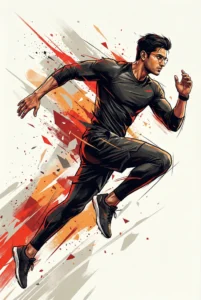


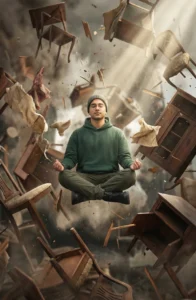
By anchoring the pose to a single moment, you reduce ambiguity and avoid stiff results.
3. Expressive Emotional Poses
Emotion lives in posture more than facial expression. Shoulders, spine, and head position communicate mood instantly.
This is where many prompts fail. A sad face on a rigid body looks artificial. A slumped posture feels real even with a neutral expression.
How to describe them conversationally:
- Instead of “sad”:
“…sitting on the floor with slumped shoulders, head lowered between their knees.” - Instead of “defensive”:
“…standing with arms crossed tightly over their chest, leaning slightly backward.” - Instead of “intense”:
“…leaning forward over the table with intent, hands gripping the edge.”
Describe what the body is doing, and let the emotion emerge on its own.
4. Hand-Focused Poses
Hands are the most common failure point in AI-generated images. This is especially true with conversational tools like ChatGPT using DALL-E 3, and Gemini.
The reason is simple.
When hand placement is unclear, the AI tries to invent a solution. That invention often leads to extra fingers, strange angles, or melted anatomy.
The fix is not negative prompts or retries.
The fix is explicit physical instruction.
How to describe them conversationally:
- “…with hands clasped gently in front of their waist.”
- “…resting one hand on their chin in a thinking posture.”
- “…holding a coffee cup with both hands to keep warm.”
- “…one hand gripping the edge of the table, the other resting flat.”

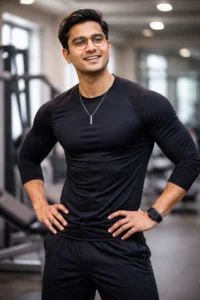


Important tip:
Avoid vague phrases like “holding an object.” Instead, say “holding a ceramic mug” or “holding a folded letter.”
When the AI knows the shape of the object, it renders the hands more accurately.
5. Cinematic and Dramatic Poses
These poses are designed for impact. They work best when you combine the physical description with camera terminology.
These poses are ideal for:
- Hero images
- Thumbnails
- Story-driven scenes
- Concept art
How to describe them conversationally:
- “…a low-angle shot looking up at the hero, who is standing in a strong, wide stance with hands on hips.”
- “…a silhouette of the figure standing in a doorway, body turned away from the camera.”
- “…a profile view of the woman looking out a window, lit only by the streetlights outside.”
Notice how each example combines: Where the body is, How it is oriented and How the camera sees it.
This removes ambiguity and produces more intentional compositions.
The “Body Part Sequencing” Method
When talking to a chatbot, it is easy to ramble. To keep your prompts clear and effective, use the Sequencing Method. Structure your sentence in this specific order:
[Body Position] + [Head Direction] + [Arm/Hand Placement]
Instead of a messy sentence like: “Make him look cool and maybe looking at us but standing sideways with crossed arms,” use the sequence:
“Generate an image of a man standing with his body turned to the side (Body), turning his head to look directly at the camera (Head), with his arms crossed over his chest (Arms).”
This structure is logical. It helps the AI build the character from the ground up without getting confused.
Troubleshooting: When the AI Ignores Your Pose
Sometimes, even with a clear description, the AI will soften or rewrite your pose into something safer and more generic. This usually happens because conversational models try to be “helpful” by reinterpreting your request.
When this happens, add a direct constraint at the end of your prompt:
“Please do not rewrite or summarize my physical description of the character. Render the pose exactly as described.”
This signals that the physical pose is not optional or stylistic. It is a hard requirement.
This technique is especially useful when generating:
- Asymmetrical or unbalanced poses
- Emotional scenes
- Unusual body language
This forces the model to adhere to your strict physical constraints rather than its own creative interpretation.
A Universal Prompt Template for ChatGPT & Gemini
You can use the template below as a reliable starting point. It is designed to work well with conversational AI without triggering internal rewrites.
The Template:
“Generate a photorealistic image of [Character Description]. They should be [Body Position: e.g., sitting on a wooden chair], with their [Head Direction: e.g., head tilted down reading a letter]. Ensure their hands are [Hand Placement: e.g., holding the paper clearly with both hands]. Frame this as a [Camera Angle: e.g., medium shot from eye level] with [Lighting: e.g., soft morning light].”
Example in action:
“Generate a photorealistic image of a futuristic mechanic. They should be kneeling on the floor next to a robot, with their head turned up looking at a hologram. Ensure their hands are holding a wrench and a tablet. Frame this as a low-angle shot with neon blue lighting.”
This format keeps everything clear, physical, and difficult to misinterpret.
Final Thoughts
Strong AI images are not created by complex vocabulary.
They are created by clear intent.
When using conversational image tools, remember this principle:
Stop describing feelings.
Start describing physics.
When you tell the AI exactly how a character poses – stands, sits, leans, and places their hands, the emotion and story emerge naturally. The result feels intentional, grounded, and human, not generic or stiff.
Once you understand how poses in AI image generation work, controlling emotion becomes far easier.